Pendant ce temps, les départements d’intégrité scientifique des éditeurs continuent l’évaluation des articles de l’IHU Méditerranée Infection. Les signalements ont été nombreux et il est difficile pour les équipes d’intégrité de tout analyser.
Des sites apportent les informations actualisées
Il existe plusieurs sources pour savoir où en sont ces investigations.
- Le blog RetractionWatch a un classement des chercheurs selon le nombre d’articles rétractés. Joachim Boldt devrait rester longtemps le leader avec ses 240 articles rétractés. Didier Raoult est en 8 ème position dans cette liste. Il y a la liste des articles rétractés les plus cités, et l’article « Hydroxychloroquine and azithromycin as a treatment of COVID-19: results of an open-label non-randomized clinical trial. » de Gautret et al est en deuxième position avec 3 202 citations, dont 3 145 avant la rétractation !
- La base de données « retraction-watch-data » qui a été créée par RetractionWatch est maintenant la propriété de Crossref. C’est une base incroyable avec bientôt 70 000 articles, mais ce ne sont pas que des articles rétractés. Il y a les EoC (Expression of Concern ou mises en garde) qui appellent une décision postérieure.
- Le site ihu-correction.com est dédié aux articles d’ l’IHU Méditerranée Infection ; ce sont 868 articles qui sont détaillés avec actualisation permanente. Sur ce site, ce sont, à ce jour, 80 articles de l’IHU qui ont été rétractées, et 67 de ces articles étaient co-signés par Didier Raoult. Le directeur actuel, Pierre-Edouard Fournier a 14 articles rétractés. Ce site est actualisé et très complet. Félicitons ceux qui œuvrent pour ce travail, et aidons les.
Des notices de rétractation parfois succinctes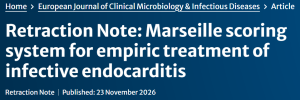
La dernière note de rétractation (23 novembre 2026) est ainsi écrite : The Editor-in-Chief has retracted this paper because the authors could not provide evidence of approval from an appropriate ethics committee. Author Didier Raoult disagrees with this retraction. None of the other authors have responded to correspondence from the Publisher about this retraction.
D’autres EoC peuvent se terminer par une correction
Par exemple, cet article de PLOS avec le titre « Complexin in ivermectin resistance in body lice » a été corrigé après l’EoC. La correction est la suivante : « Following the editorial investigation, the concerns pertaining to the article’s adherence to PLOS’ research ethics policies were dismissed. The authors did not respond to the journal’s queries about competing interests. Based on publicly available information, the Editors update the article’s Competing Interests statement to: At the time this article was submitted, DR was listed as a co-founder and member of the scientific council of Arthrobac Pharma. With this update, the PLOS Genetics Editors consider the issues described in [2] to be resolved. This Correction supersedes the prior Expression of Concern ». Ce travail de correction est long : la correction du 30 juillet 2026, alors que l’EoC est du 13 décembre 2022, et elle concerne un article du 6 août 2018 !
Des EoC, notamment chez PLOS sont parfois très détaillés… incroyable
Je vous suggère de lire cet EoC, copié ci-dessous, pour imaginer la qualité du travail du groupe intégrité de cet éditeur. Il s’agit d’un EoC du 28 avril 2026, à propos de l’article « Detection of Plant DNA in the Bronchoalveolar Lavage of Patients with Ventilator-Associated Pneumonia » publié le 24 juin 2010. Ce sont des commentaires sur PubPeer qui ont alerté PLOS. Vous verrez qu’il est impossible de conclure !!! Cet EoC n’apporte pas de conclusion.
Following the publication of the article PLOS investigated concerns pertaining to the reported ethical approval and the article’s adherence to PLOS One’s research ethics policies.
Specifically, the research ethics concerns included that the study involved human participants but did not receive ethics approval from a Comité de Protection des Personnes, and that the ethics approval number #07–026 was also reported in multiple other publications [2–4], [5–7], and [8,9, retracted in 10], despite differences in the requirements for consent reported in these articles.
The study describes the use of bronchoalveolar lavage and blood samples collected from intensive care unit patients with ventilator-associated pneumonia, but does not clarify when these samples were collected. The article describes that consent was obtained from next-of-kin, and that the project was approved by the Local Ethics Committee of the Université de la Méditerranée (Marseille, France), with the permit number: 07–026.
A representative of the Aix-Marseille Université Ethics Committee stated that the institutional investigation into the ethics concerns concluded this article meets ethical standards. They commented that the study described in [1] is a retrospective study of samples taken in intensive care units as part of routine patient care, and that the study did not require ethics approval from a Comité de Protection des Personnes according to French law. Furthermore, the representative stated that these articles resulted from the same retrospective study and therefore the same ethics approval document applied to all articles. They provided the ethics approval document #07–026 for editorial review.
Ethics approval document #07–026 was issued by the Comité d’Éthique de l’Institut Fédératif de Recherché de la Faculté de Médecine de Marseille (IFR48, Marseille, France) on February 19, 2007, for a study titled: “Recherche de nouveaux agents de pneumopathies nosocomiales par une approche métagénomique différentielle.” It allows for the use of blood, urine, and respiratory samples collected for diagnostic purposes, but the document does not clarify where the samples were collected or for how long the approval remained valid.
PLOS reviewed the explanation and documentation provided by the institution and concluded that the documents did not fully resolve the concerns. Specifically,
- If all articles were part of the same larger study, concerns remain about inconsistencies between the reporting of the study design in the articles’ Methods/Materials and Methods sections (no reporting in [1] and [2–4] and reported as a prospective study in [5–7] and [8,9 retracted in 10]), and the institute’s reporting of the study design (retrospective).
- If all articles were part of the same larger study, concerns remain about inconsistencies between the reporting of consent obtained for the study in each article (written consent obtained from next-of-kin reported in [1], [2–4], and [5–7], need for written consent waived by the ethics committee [8,9, retracted in 10]), a statement that there are no written consents for this study previously provided by the institute [10], and the information in the ethics document #07–026 stating that patient consent was obtained.
- PLOS identified potential competing interests between multiple members of the approving ethics committee and one or more of the article’s authors.
PLOS has not been able to secure input from an independent official confirming whether or not this study should have been subjected to CPP approval as per French legislation.
The PLOS One Editors issue this Expression of Concern to notify readers of the concerns pertaining to the article’s compliance with the journal’s research ethics policies.

